
Join us on 22 October at 6 pm.

Join us on 22 October at 6 pm.

Keynote Speaker: Oliver Naidu, Vopak President; Zululand Energy Terminal, Director. Click here to RSVP
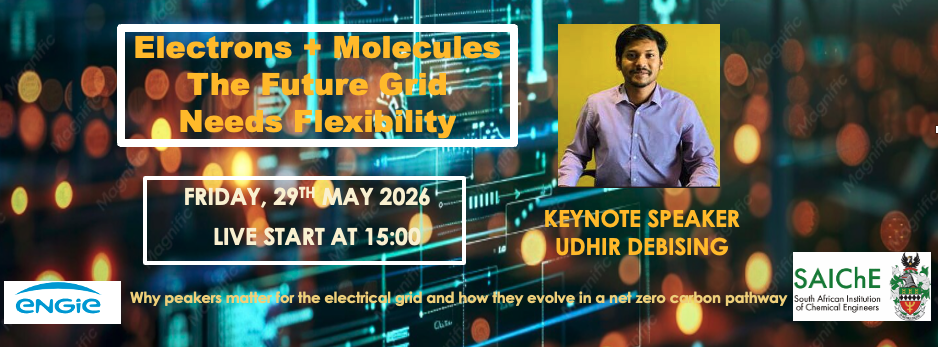
A webinar was held by the KZN branch on Friday, 29th May 2026 at 15h00.
The speaker was Udhir Debising who addressed us on the topic
Electrons + Molecules: The Future Grid Needs Flexibility
Why peakers matter for the electrical grid and how they evolve in a net zero carbon pathway.
Abstract:
As South Africa expands renewable energy, grid flexibility remains essential to reliability, affordability, and security of supply.
The Medium-Term System Adequacy Outlook published by Eskom shows that higher unplanned outages as well as the country’s net zero carbon ambition still translate into higher unserved energy risk, even as overall system performance improves.
This presentation examines peaking power as a critical flexibility resource, highlighting how Open Cycle Gas Turbines (OCGTs) support peak demand, system resilience, and renewable integration.
It also explores pathways to lower-carbon molecules (renewable gases, hydrogen, and carbon-circular fuels), as a practical means of preserving fast-response capability while reducing lifecycle emissions.
Short Bio of the Speaker Udhir Debising
Udhir Debising is a seasoned energy professional with over a decade of experience spanning digital innovation and operational excellence in South Africa's power generation sector. He holds a BScEng in Chemical Engineering from the University of KwaZulu-Natal.
Udhir began his career at the intersection of engineering and technology, developing digital twin platforms for thermal power plants. He currently serves as Commercial & Performance Engineer at ENGIE Peakers Operations, where he is responsible for the commercial optimisation and technical performance of the Avon and Dedisa peaking power stations — a combined installed capacity of 1 GW. His expertise lies in driving plant efficiency, supporting grid stability, and navigating the complexities of South Africa's energy transition.

Future-proofing careers: SAIChE hosts successful Student membership drive at MUT
The Student Centre foyer at Mangosuthu University of Technology (MUT) was abuzz with professional ambition on 5 March 2026 as the South African Institution of Chemical Engineers (SAIChE) hosted a high-impact membership drive for the Department of Chemical Engineering.
The event, aimed at bridging the gap between classroom theory and industrial reality, and the importance of being the right person for the job, provided students with a roadmap for professional registration and career longevity. Dr Marc Tshibangu, Senior Lecturer at MUT and SAIChE-KZN Deputy Chairperson, emphasised that the drive was a crucial step in "fostering professional engagement and preparing future chemical engineers for successful careers."
Representing the Head of Department, Njabulo Zulu opened the proceedings by urging students to take an active role in their professional development. The message from the podium was clear: technical skills are the foundation, but professional networking is the catalyst for a successful career.
Key industry and academic figures shared insights on the evolving landscape of the field. Sbu Ntshantshali, SAIChE-KZN, provided a comprehensive overview of membership tiers tailored for students. Joandie Naidoo, SAIChE-KZN Public Relations, highlighted "workplace readiness," stressing that recruitment often favours those who demonstrate professional conduct and early commitment to the industry through bodies like SAIChE, while Dr Khalid Osman, MUT Senior Lecturer, demystified the path to professional registration with the Engineering Council of South Africa (ECSA), a critical milestone for any aspiring engineer.
For the students in attendance, the drive was not only about networking; it was about accessing a robust toolkit designed to support their journey from the lecture hall to the plant floor.
Some key membership benefits highlighted include receiving professional recognition, as SAICE is an ECSA-accredited Voluntary Association. Membership may count toward Professional Engineer (Pr.Eng) registration.
Members also receive educational support; SAIChE maintains high academic standards by participating in university audits and educational forums. Additionally, members have access to regional branches and special interest groups, as well as opportunities to serve on committees to build leadership skills.
As a member, one also benefits from accessing a dedicated member portal for continuing professional development (CPD) courses, research presentation opportunities at the SAChE Congress, and discounted rates on journals and books. Also, through the World Chemical Engineering Council (WCEC), SAIChE links local students to the international engineering community.
The event saw a strong showing from the SAIChE-KZN leadership, including Secretary Dr Nkululeko Nkosi, Treasurer Dr Lasich Madison, and National Secretary Elly Obwaka. Their presence underscored the Institution's commitment to nurturing the next generation of South African Chemical engineers.
As the drive concluded, the sentiment among the students was one of empowerment. By joining SAIChE early, MUT's chemical engineering cohort is earning a certificate and is gaining a lifelong professional family.

The KwaZulu-Natal Branch Committee of the South African Institution of Chemical Engineers (SAIChE) held its annual year-end function on 7 December 2025 at Jack’s Grill, Manor House, in Durban. The event brought together committee members for a constructive reflection on the year’s activities, strategic planning for the future, and a celebration of the Branch’s continued contribution to the chemical engineering profession in the province.
The session opened with a review of the Branch’s operational and governance matters. Committee members discussed and agreed on the forthcoming change of signatories to strengthen administrative efficiency and ensure alignment with the SAIChE’s national governance standards. This transition is intended to streamline financial processes and enhance accountability as the Branch prepares for an active year ahead.
A key focus of the engagement was the development of the 2026 calendar of events, including annual general meetings, technical seminars, professional development workshops, student outreach initiatives, and industry engagement sessions. The committee emphasised the importance of delivering a structured and high-impact programme that supports continuous professional development (CPD) and strengthens the visibility of chemical engineers across the KwaZulu-Natal province. A critical focus area for the committee would be to ensure the skilling and readiness of the chemical engineering students for the work-place through consultative discussions with industry and the university.
To improve communication and operational effectiveness, the Branch resolved to establish dedicated email accounts for committee members. The objective is to centralise correspondence, enhance response times, and create a clear communication interface for members, partners, students, and stakeholders. Additionally, the Branch discussed plans for a dedicated website, which will serve as a central platform for event announcements, technical resources, committee updates, and enhanced engagement with the broader chemical engineering community.
The event concluded with a reflection on the Branch’s achievements in 2025 and an expression of appreciation to committee members, industry partners, and volunteers for their sustained commitment to advancing chemical engineering in KZN. The Branch looks forward to 2026 as a year of renewed growth, increased activity, and strengthened collaboration.